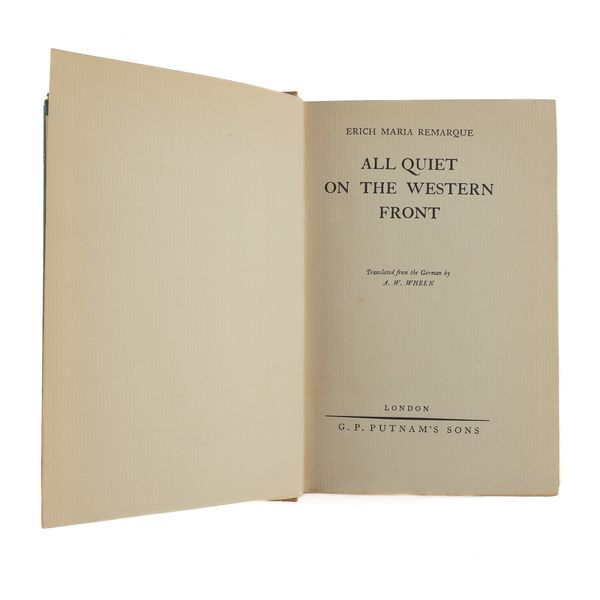
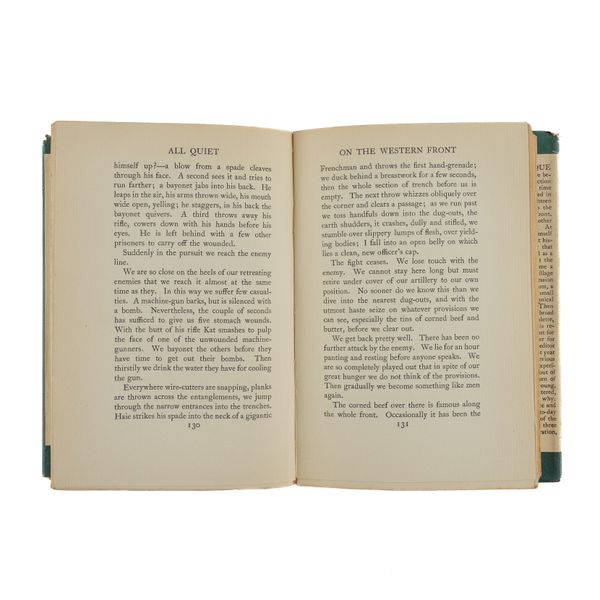
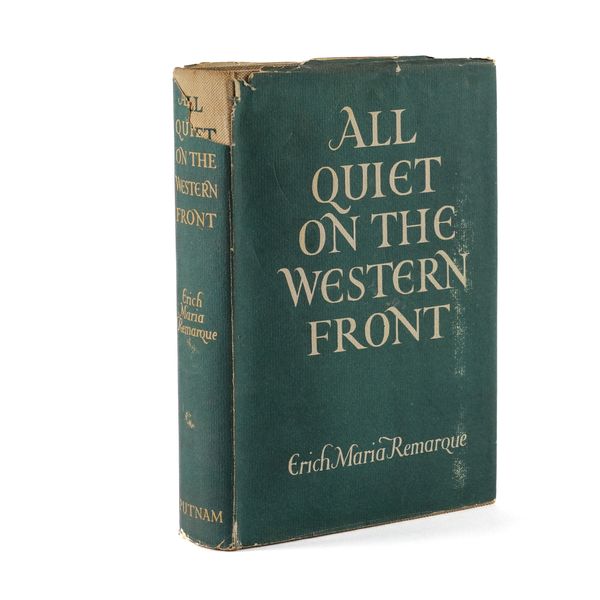
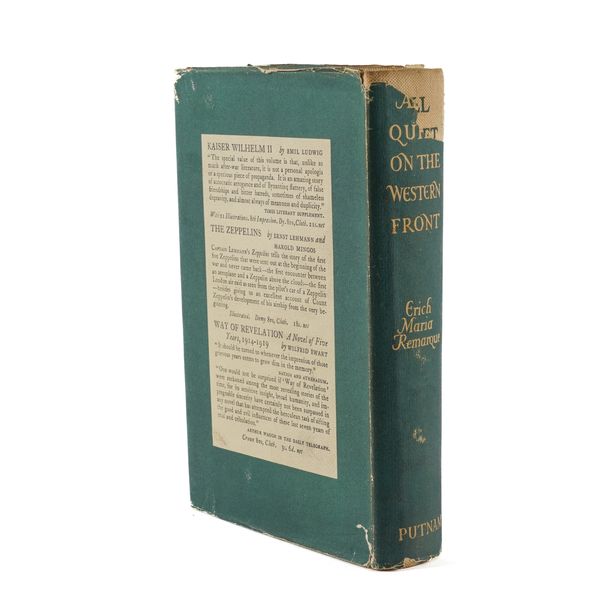
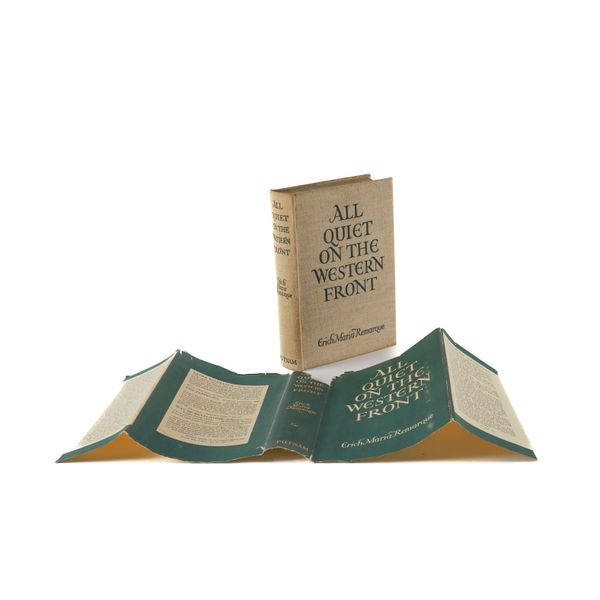
REMARQUE, Erich Maria (1898-1970). All Quiet on the Western Front, London, 1929, 8vo, original tan hessian lettered in green, dust-jacket (a section torn away from the backstrip). FIRST U.K. EDITION of one of the most important of all anti-war novels.
| Starting bid | £300 |
| Estimate | £400 - £600 |
| Absentee deadline | Dec 3, 2025, 5:00:00 PM |
REMARQUE, Erich Maria (1898-1970). All Quiet on the Western Front. Translated from the German by A. W. Wheen. London: G. P. Putnam's Sons, March 1929. 8vo (190 x 125mm). Half title. Original publisher's tan hessian lettered in dark green (rectangle of light browning to endpapers), dust-jacket with "German Opinions" by Walter van Molo, Erich Koch-Weser, Ersnt Toller, Bruno Frank, Carl Bulcke and Redakteur Stohr on the front turn-in and the price of 7s. 6d. unclipped (a section at the head of the backstrip torn away with loss of five letters of the title, some fraying and rubbing at corners, some very light rubbing to the upper wrapper, short tear at lower edge). FIRST U.K. EDITION of one of the most important and influential of all anti-war novels. The first German edition was published two month's prior to the English in January 1929, having been initially serialised in the newspaper "Vossische Zeitung". "This book is to be neither an accusation nor a confession, and least of all an adventure, for death is not an adventure to those who stand face to face with it. It will try simply to tell of a generation of men who, even though they may have escaped its shells, were destroyed by the war" (the author's own epigraph to the English edition). "I am young, I am twenty years old; yet I know nothing of life but despair, death, fear, and fatuous superficiality cast over an abyss of sorrow. I see how peoples are set against one another, and in silence, unknowingly, foolishly, obediently, innocently slay one another. I see that the keenest brains of the world invent weapons and words to make it yet more refined and enduring. And all men of my age, here and over there, throughout the whole world, see these things; all my generation is experiencing these things with me. What would our fathers do if we suddenly stood up and came before them and proffered our account? What do they expect of us if a time ever comes when the war is over? Through the years our business has been killing; - it was out first calling in life. Our knowledge of life is limited to death. What will happen afterwards? And what shall come out of this?" (from pp.287-288). The book was banned, and publicly burned, in Nazi Germany. Boxall (ed.) 1001 Books (2006) p.337: "... Remarque's text does not assume or argue for pacifism; it simply enacts it as an appalled response to the daily efficiencies of organised slaughter. It is this quiet, certain, yet exploratory demonstration of the utter inhumanity of war that constitutes the magnificence of All Quiet on the Western Front."
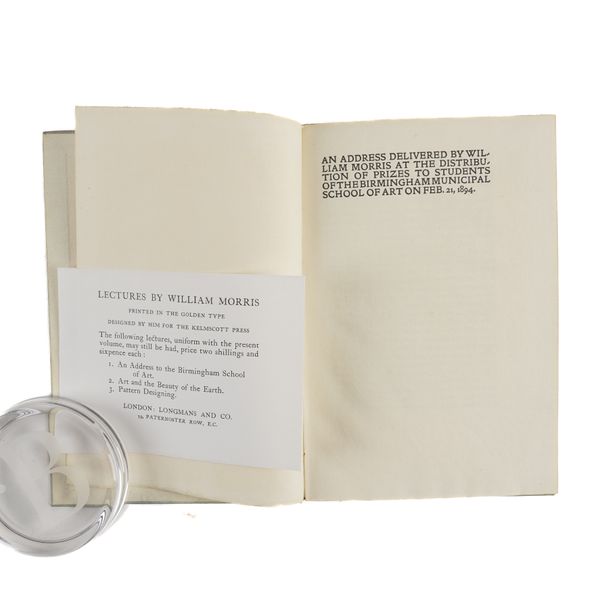
![TURNER, Richard ([?]1720-91). A View of the Earth: Being a short, but Comprehensive System of Modern Geography, London, 1762, 4to, engraved map of the world, 6 maps, plate, diagrams, boards (worn). And 2 contemporary manuscript exercise books. (3)](https://scc.snoofa.com/image/snoofa-tenant-bellmans/images%2Flot-numbers%2FDEC-BOOKS-2025%2Fwo30nopmu0rm8ryiapo4690e125b7069c332258930%2FFull%2F509.jpg)
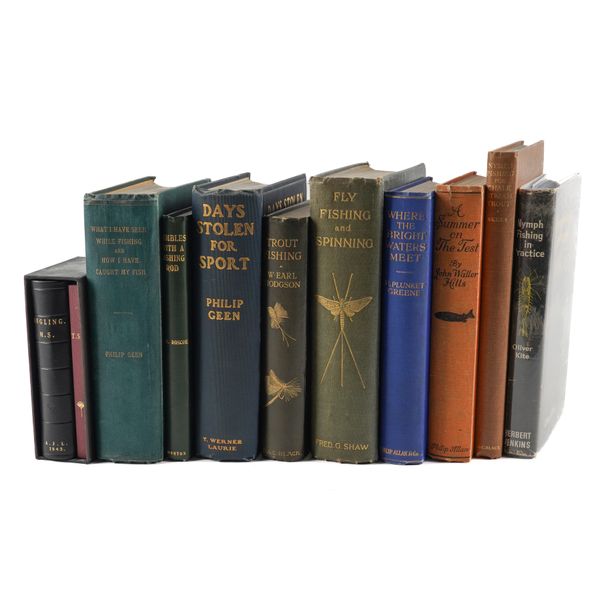
![[PHILLIPS, Richard (1767-1840)]. The Wonders of the Telescope; or, a Display of the Starry Heavens and of the System of the Universe, London, 1809, 8vo, 14 engraved plates, contemporary boards. "New Edition." With 9 other works in 12 vols. (13)](https://scc.snoofa.com/image/snoofa-tenant-bellmans/images%2Flot-numbers%2FJULY-BOOKS-2025%2F8mramarryamzevt540hz68567a453c0cf824845942%2FFull%2F389.jpg)
![[HANWAY, Jonas (1712-86)]. A Journal of Eight Days Journey from Portsmouth to Kingston upon Thames, London, 1756-58, 4to, 4 engraved plates, contemporary calf. FIRST EDITION. With 3 other works in 5 volumes. (6)](https://scc.snoofa.com/image/snoofa-tenant-bellmans/images%2Flot-numbers%2FDEC-BOOKS-2025%2Fwo30nopmu0rm8ryiapo4690e125b7069c332258930%2FFull%2F441.jpg)
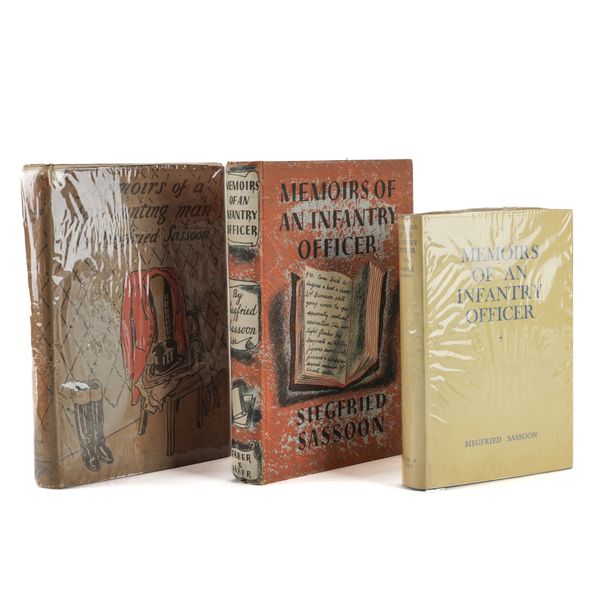
![LOVECRAFT, H. P. (1890-1937). The Shunned House, Athol, Mass.: The Recluse Press, 1928 [but please see the important note in the full description below]. Original publisher's black cloth gilt, modern book box. Joshi A5. EXCEPTIONALLY RARE.](https://scc.snoofa.com/image/snoofa-tenant-bellmans/images%2Flot-numbers%2FDEC-BOOKS-2025%2Fv0y9k8v41xfda2jnj4w569135f42d0092550395446%2FFull%2F458.jpg)
![[POUND, Ezra (1885-1972), editor] - Guido CAVALCANTI (1255-1300). Rime ... Edizione Rappezzata fra le Rovine, Genova, "Edizioni Marsano S. A.", 1931, 4to, original red wrappers. ONE OF 500 COPIES, POSSIBLY A PRESENTATION COPY, [?]inscribed by Ezra Pound.](https://scc.snoofa.com/image/snoofa-tenant-bellmans/images%2Flot-numbers%2FDEC-BOOKS-2025%2Fwo30nopmu0rm8ryiapo4690e125b7069c332258930%2FFull%2F487.jpg)