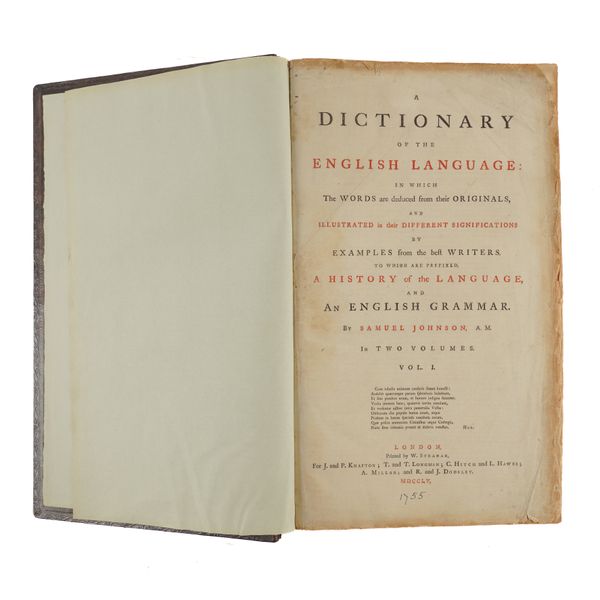
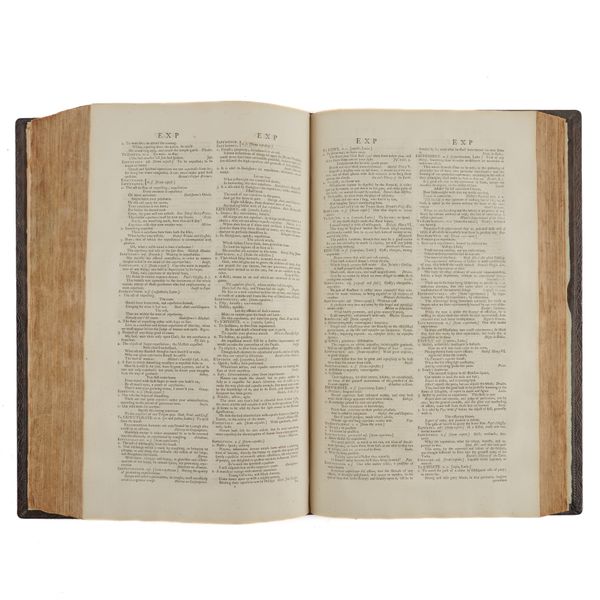
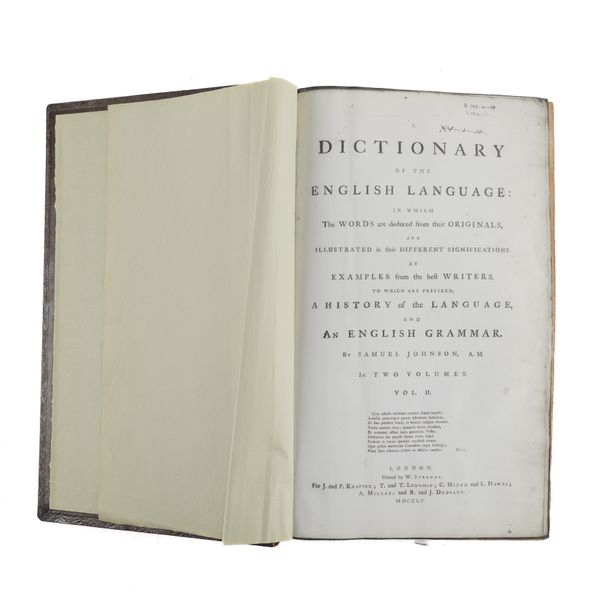
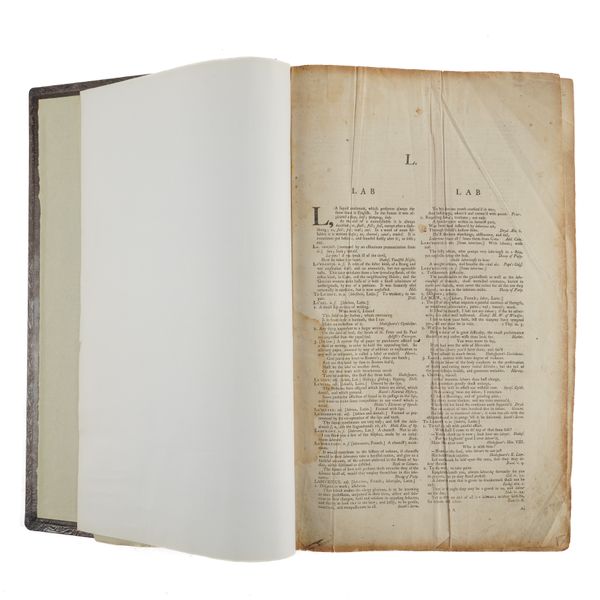
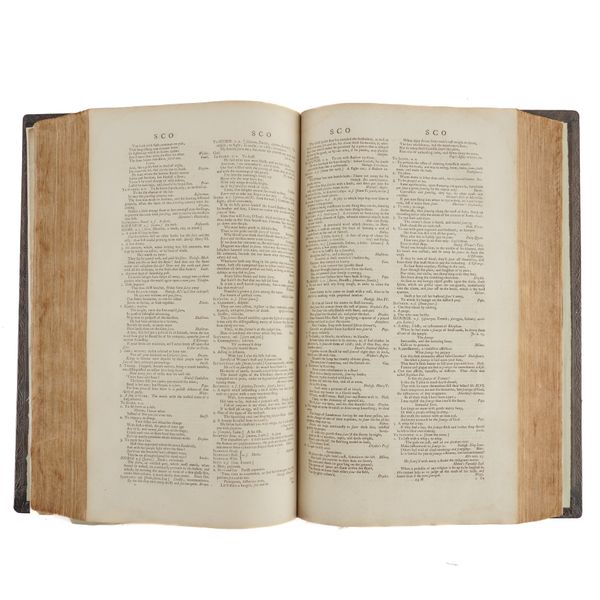
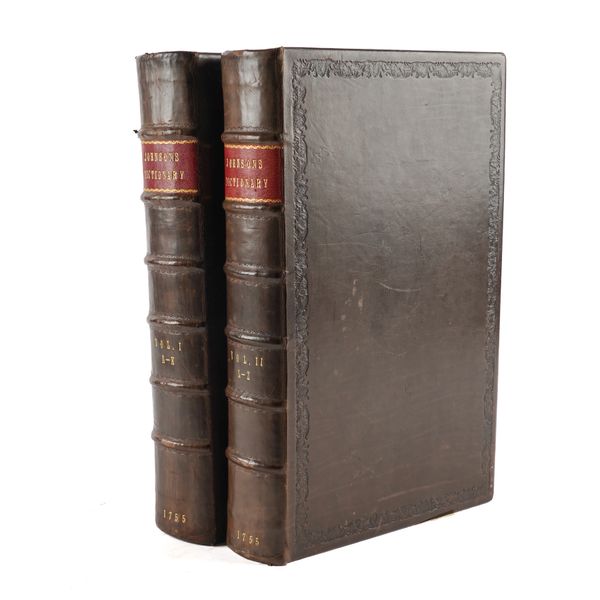
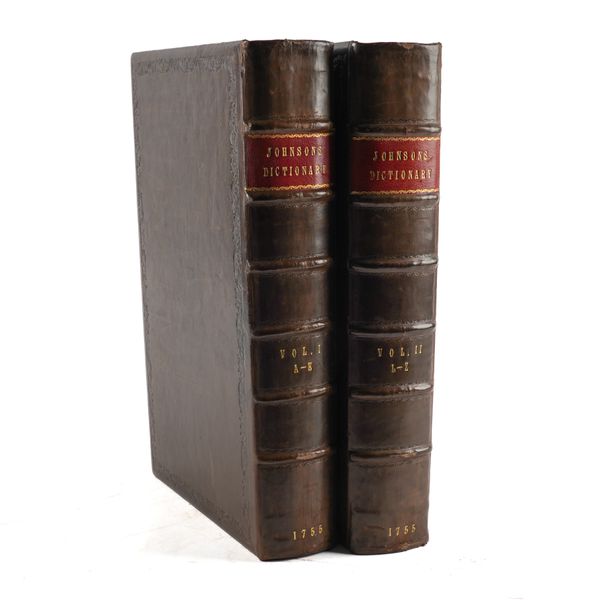
JOHNSON, Samuel (1709-84). A Dictionary of the English Language, London, 1755, 2 volumes, folio, lacking the title to vol. II, but supplied in modern facsimile, modern old-style calf. FIRST EDITION, FIRST ISSUE. (2)
| Starting bid | £1,000 |
| Estimate | £2,000 - £3,000 |
| Absentee deadline | Dec 3, 2025, 5:00:00 PM |
JOHNSON, Samuel (1709-84). A Dictionary of the English Language: in which the Words are Deduced from their Originals, and Illustrated in their Different Significations by Examples from the Best Writers, to which are Prefixed, a History of the Language and an English Grammar. London: "Printed by W. Strahan, For J. and P. Knapton; T. and T. Longman; C. Hitch and L. Hawes; A. Millar; and R. and J. Dodsley," 1755. 2 volumes, folio (420 x 260mm). Title to volume one printed in red and black, printed almost entirely in double column, ornaments (lacking the title page to volume two which has been supplied in functional modern facsimile, followed immediately by the leaf with the signature 15A, the title page to volume one lightly browned and torn at the edges and frayed without loss, some mainly marginal staining at the front and end of volume one, occasional mainly light marginal spotting and staining). Modern old-style calf (lightly scuffed, new endpapers). Provenance: From the Collection of Clive Wilmer (1945-2025; please see lot 418 for further biographical information); G. David Bookseller, Cambridge (small modern bookseller's label on the front pastedowns). FIRST EDITION, FIRST ISSUE, conforming to Todd's requirements of the first issue that the verso of 19D has the press figure '9' and the verso of the following leaf the figure '7'. In addition, the seventh definition of the word "Part" has the quotation sources both written out in full (Bacon's Natural History and Milton's Paradise Lost) rather than abbreviated, as they were the in second issue. "Dr Johnson performed with his Dictionary the most amazing, enduring and endearing one-man feat in the field of lexicography ... The preface ranks among Johnson's finest writings ... It is the dictionary itself which justifies Noah Webster's statement that 'Johnson's writings had, in philology, the effect which Newton's discoveries had in mathematics'. Johnson introduced into English lexicography principles which had already been accepted in Europe but were quite novel in mid-eighteenth-century England. He codified the spelling of English words; he gave full and lucid definitions of their meanings (often entertainingly coloured by his High Church and Tory propensities); and he adduced extensive and apt illustrations from a wide range of authoritative writers ... [D]espite the progress made during the past two centuries in historical and comparative philology, Johnson's book may still be consulted for instruction as well as pleasure" (PMM). Brunet II, 725 (citing the fourth edition of 1773); Chapman & Hazen Johnsonian Bibliography (1938) p.137; Courtney & Smith A Bibliography of Samuel Johnson (1915) p.54; Fleeman A Bibliography of the Works of Samuel Johnson (2000) I, p.410; PMM 201; The Rothschild Library. A Catalogue of the Eighteenth-Century Printed Books and Manuscripts formed by Lord Rothschild 1237. (2)
![TURNER, Richard ([?]1720-91). A View of the Earth: Being a short, but Comprehensive System of Modern Geography, London, 1762, 4to, engraved map of the world, 6 maps, plate, diagrams, boards (worn). And 2 contemporary manuscript exercise books. (3)](https://scc.snoofa.com/image/snoofa-tenant-bellmans/images%2Flot-numbers%2FDEC-BOOKS-2025%2Fwo30nopmu0rm8ryiapo4690e125b7069c332258930%2FFull%2F509.jpg)
![[PHILLIPS, Richard (1767-1840)]. The Wonders of the Telescope; or, a Display of the Starry Heavens and of the System of the Universe, London, 1809, 8vo, 14 engraved plates, contemporary boards. "New Edition." With 9 other works in 12 vols. (13)](https://scc.snoofa.com/image/snoofa-tenant-bellmans/images%2Flot-numbers%2FJULY-BOOKS-2025%2F8mramarryamzevt540hz68567a453c0cf824845942%2FFull%2F389.jpg)
![[HANWAY, Jonas (1712-86)]. A Journal of Eight Days Journey from Portsmouth to Kingston upon Thames, London, 1756-58, 4to, 4 engraved plates, contemporary calf. FIRST EDITION. With 3 other works in 5 volumes. (6)](https://scc.snoofa.com/image/snoofa-tenant-bellmans/images%2Flot-numbers%2FDEC-BOOKS-2025%2Fwo30nopmu0rm8ryiapo4690e125b7069c332258930%2FFull%2F441.jpg)
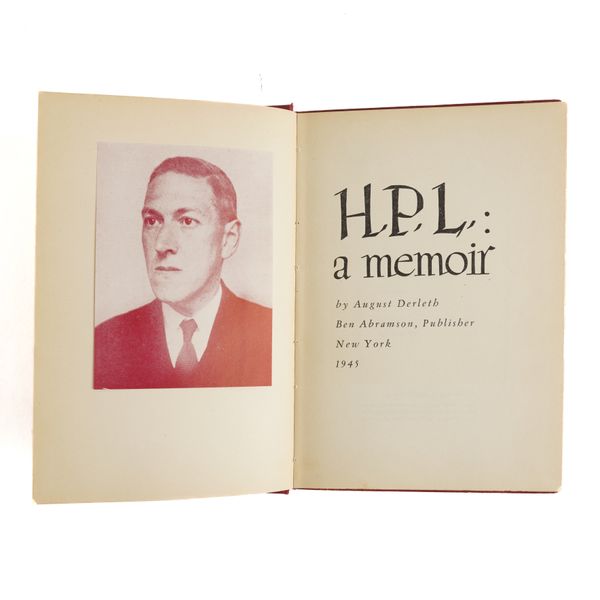
![LOVECRAFT, H. P. (1890-1937). The Shunned House, Athol, Mass.: The Recluse Press, 1928 [but please see the important note in the full description below]. Original publisher's black cloth gilt, modern book box. Joshi A5. EXCEPTIONALLY RARE.](https://scc.snoofa.com/image/snoofa-tenant-bellmans/images%2Flot-numbers%2FDEC-BOOKS-2025%2Fv0y9k8v41xfda2jnj4w569135f42d0092550395446%2FFull%2F458.jpg)
![[POUND, Ezra (1885-1972), editor] - Guido CAVALCANTI (1255-1300). Rime ... Edizione Rappezzata fra le Rovine, Genova, "Edizioni Marsano S. A.", 1931, 4to, original red wrappers. ONE OF 500 COPIES, POSSIBLY A PRESENTATION COPY, [?]inscribed by Ezra Pound.](https://scc.snoofa.com/image/snoofa-tenant-bellmans/images%2Flot-numbers%2FDEC-BOOKS-2025%2Fwo30nopmu0rm8ryiapo4690e125b7069c332258930%2FFull%2F487.jpg)