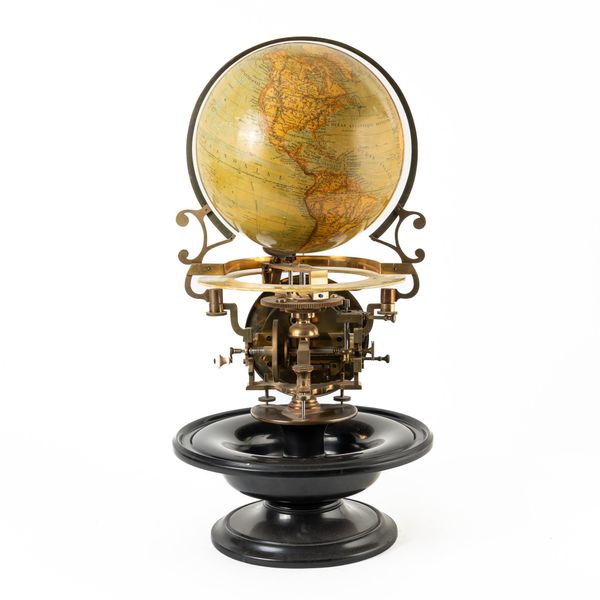
A RARE AND UNUSUAL ‘PENDULE COSMOGRAPHIQUE MOURET’ WORLD TIMEPIECE WITH EQUATION OF TIME
| Starting bid | £2,000 |
| Estimate | £2,000 - £4,000 |
| Absentee deadline | Dec 3, 2025, 12:00:00 PM |
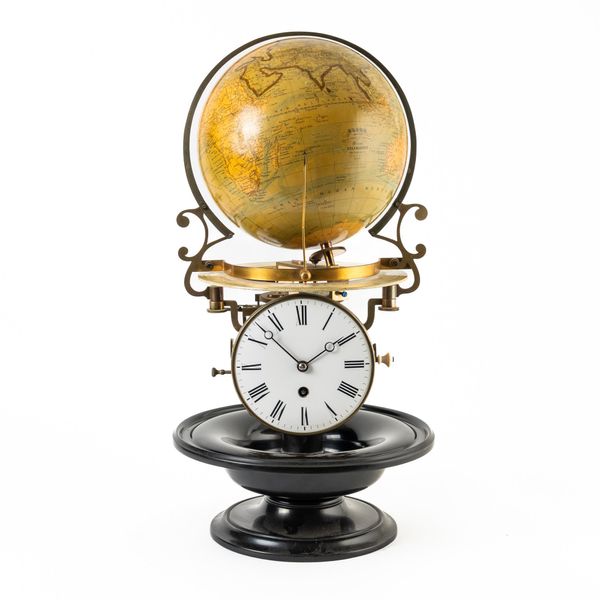
After the design by Louis-Jérôme-Napoléon Mouret The globe by Maison Delamarche, 25 rue Serpente, Paris, the movement by Charles Henard & Cie, Paris, circa 1890
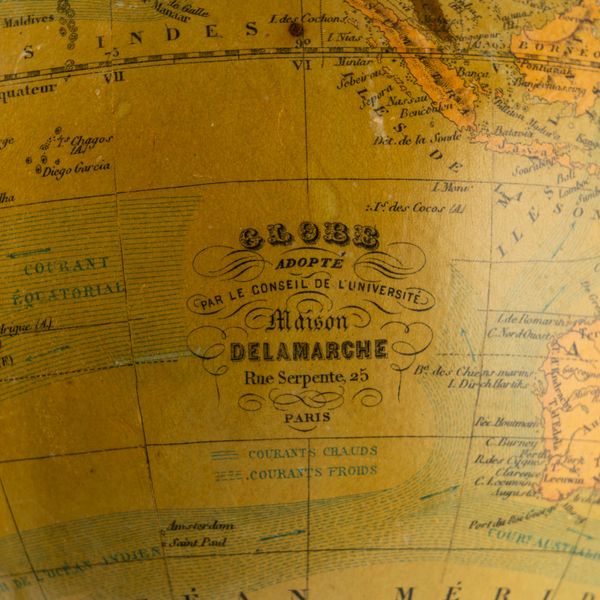
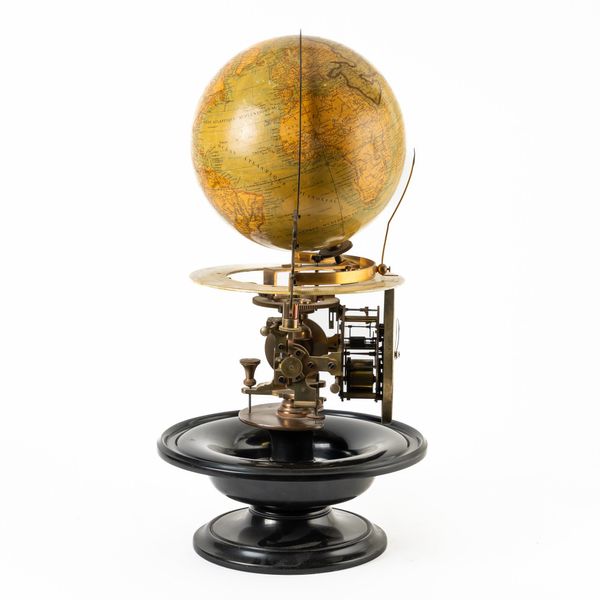
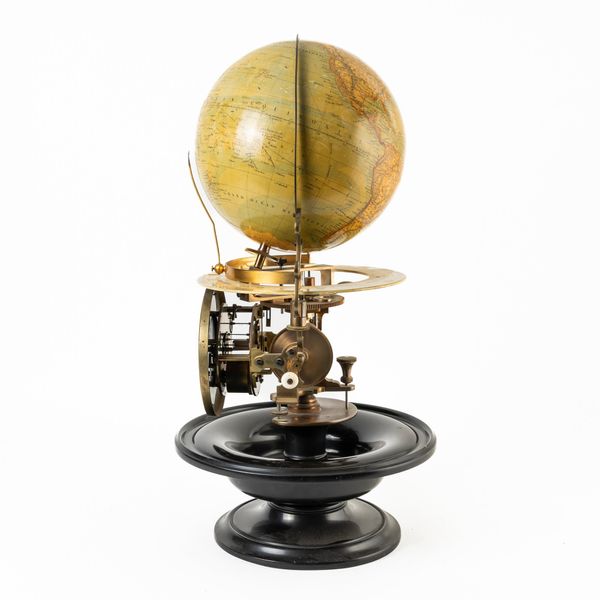
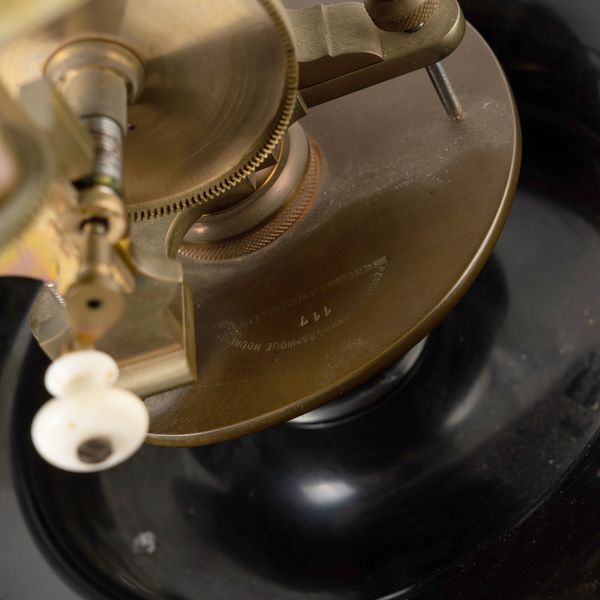
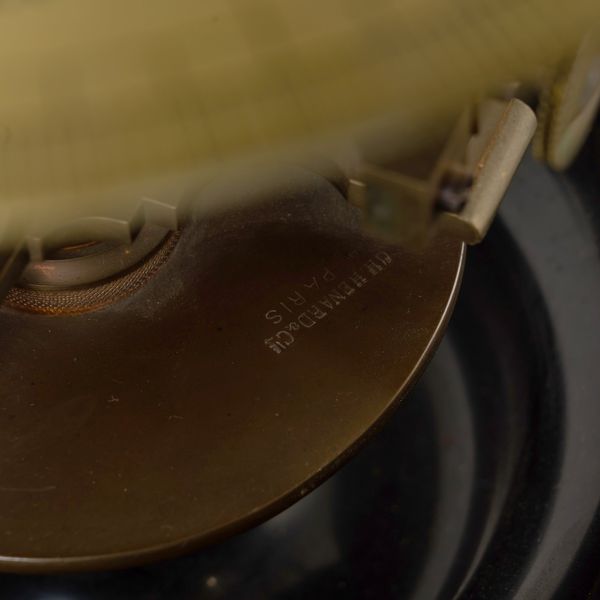
Surmounted by the globe, with printed inscription ‘GLOBE/ADOPTÉ/PAR LE CONSEIL DE L’UNIVERSITÉ/ Maison/DELAMARCHE/rue Serpente 25/Paris, with arrow hand above a painted ring showing the months and calibrated with a line for each day of each month, above a white enamel 5 1/2in dial with blued steel moon hands, the drum-shaped movement no 2433 with single train and Brocot deadbeat escapement, driving the world time mechanism, mounted on a plate stamped CH. HENARD & CIE / PARIS, also stamped in an arc PENDULE COSMOGRAPHIQUE MOURET / BREVETEE SGDG EN FRANCE & ETRANGER and numbered 117 to the centre, on a turned black marble dished base with stepped foot
54cm high
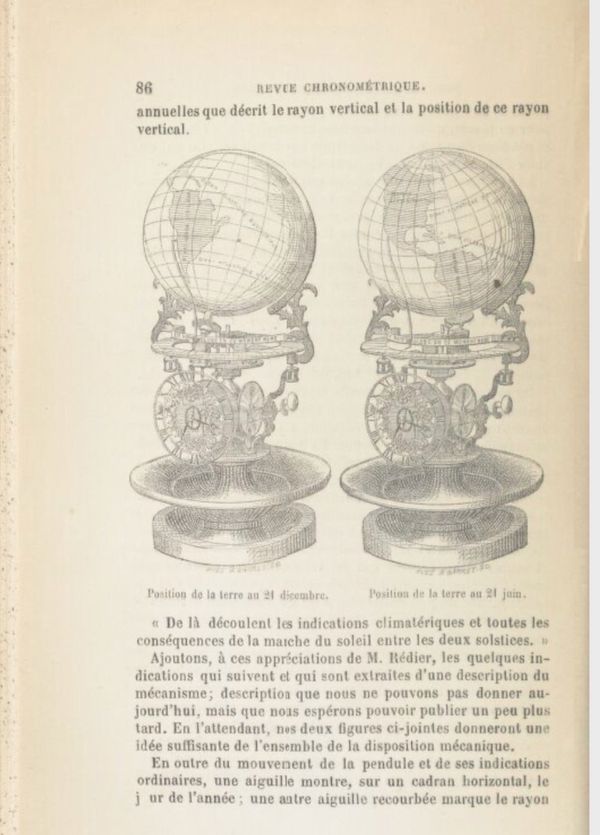
The design of this clock was conceived by Louis-Jérôme-Napoléon Mouret (b. 1810), who in 1876 submitted a patent for his invention. Mouret was a civil engineer, based at 13 rue Gaillon, Paris. His energy for this theme is demonstrated by the constant submissions of patents. In 1874 he submitted one for improvements in the arrangement and construction of model globes driven by clockwork for the purpose of demonstrating at all times all the astronomical phases of the earth with reference to the sun (The Commission of Patents Journal, 1874, p. 2483, patent no. 2699, of which an earlier patent for a similar mechanism was filed in August 1871). His patent for the present clock was submitted in June 1876 and published in detail in a number of learned publications, including a review by in L’Année Scientifique et Industrielle 1878, pp. 160-1 and also La Nature Revue des Sciences et leurs Applications aux Arts et à l’Industrie, 1877, where on p. 45 an almost identical clock is illustrated.
The globe is mounted on its axis and rotates once every
24 hours mimicking the Earth's daily rotation.
This rotation is driven by the clock's going train, so the globe's
motion is synchronised with the mean solar time (the time kept by the
clock). The horizontal calendar ring
shows the day and month and is linked to the globe and clock. As the globe rotates, the calendar ring
rotates once per year, indicating the Earth's position around the sun. The
meridian circle represents the local noon line.
As the globe's rotation is constant (mean time) and the sun's apparent
motion along the ecliptic varies, the position of the indicator relative to the
meridian circle effectively displays the Equation of Time. The difference between the clock's hands and the
globe indicator effectively allows one to read the Equation of Time directly.
Delamarche's globe business, established in the 18th century, were the first
French cartographers to produce affordable globes for the general public. The coloured paper is marked with a wide
range of geographical details including mountain ranges and continents, ocean
currents, etc.
COMPARATIVE LITERATURE:
Revue Chronométrique, Paris, Vol. IX, 1876-77, p. 84-87.
La Nature Revue des Sciences et leurs Applications aux Arts et à l’Industrie, 1877, p. 45.
L’Année Scientifique et Industrielle 1878, pp. 160-161.
Another, the movement stamped by J. Poncelet, with annular chapter ring, sold Christie's, London 24 June 1998, lot 44.
Another sold Mes Delorme et Collin du Bocage, Paris 7 December 2005, lot 137.
Another sold Thierry de Maigret, Paris, 28 October 2016, lot 128.
CONDITION REPORT
No winding key. One small pinion wheel is loose and present. The movement is dusty and would benefit from a clean and service.
This lot contains ivory
and has been registered in accordance with the Ivory Act (section 10). Reference TGXCP3DK
Prospective buyers should be aware that some
countries have limitations on importing items made from endangered species,
including materials such as coral, ivory, and tortoiseshell. Therefore, it is
advisable for potential buyers to familiarise themselves with relevant customs
regulations before placing bids, particularly if they intend to import this lot
into another country.