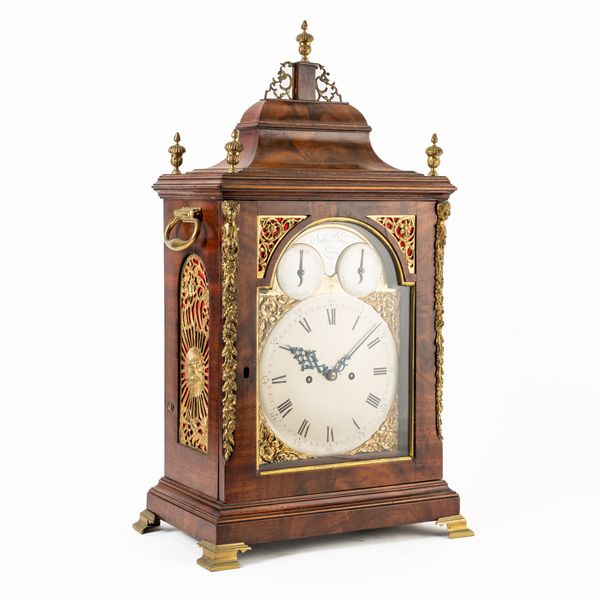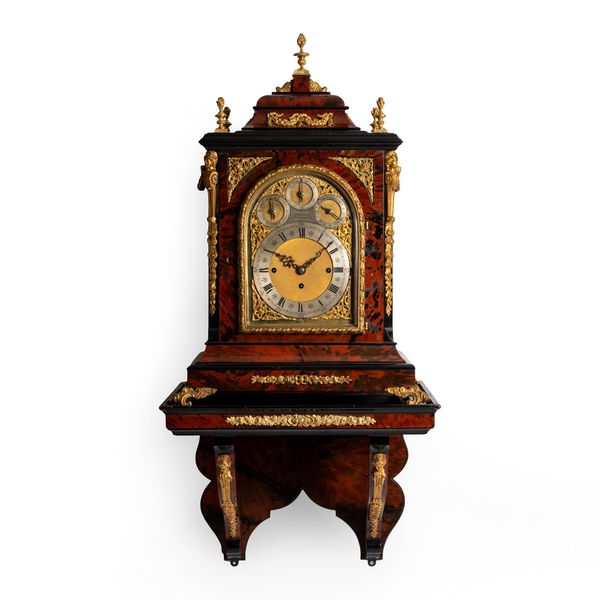
AN IMPRESSIVE LARGE 10 BELL FIVE GONG QUARTER-CHIMING GILTMETAL-MOUNTED TORTOISESHELL-VENEERED BRACKET CLOCK AND BRACKET
| Starting bid | £3,500 |
| Estimate | £4,000 - £6,000 |
| Absentee deadline | Dec 3, 2025, 12:00:00 PM |
Signed John Creed Jennens & Son, London, circa 1868
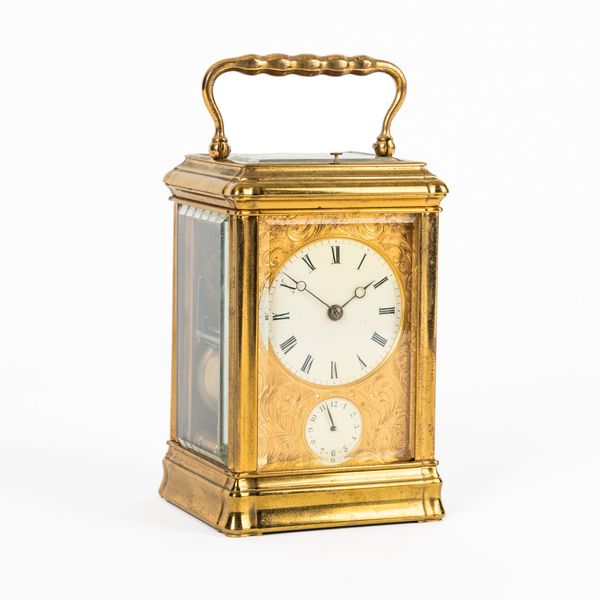
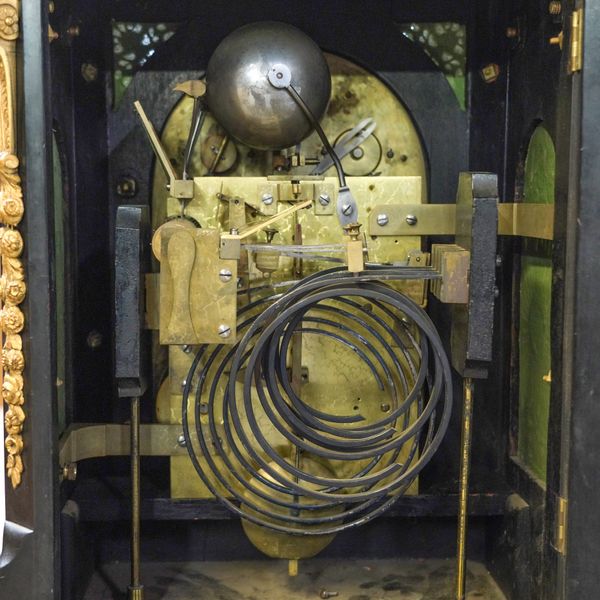
The case with stepped dome centre, surmounted by a large flame finial and with four smaller finials below, above moulded cornice, the front with a pair of cherub mask winged spandrels flanking an arched foliate cast door surround with bevelled plate, the 8 1/2in arched brass dial with matt gilt cast spandrels, three subsidiaries for Regulation; CHIME/SILENT; WESTMINSTER/TEN BELLS/EIGHT BELLS, with signature panel engraved J. C. JENNENS & SON / LONDON above the silvered chapter ring enclosing a matted centre with pierced blued steel hands, the canted case corners each with a female caryatid, the sides each with a cast handle above pierced cast mask panels, on a stepped base with foliate cast feet, the substantial three train chain fusée movement signed to the backplate J. C. JENNENS & SON / 25 & 26 GREAT SUTTON STREET / LONDON with long projecting pin wheel to chime each quarter on either 8 or 10 bells or four blued steel gongs, striking the hour on a larger fifth gong
The clock 72cm high; the bracket 36cm high; overall 108cm high
John Creed Jennens, often signing his work “J.C. Jennens, London,” was a distinguished Victorian clockmaker active during the mid- to late-19th century. He began his career in Birmingham, later moving to Clerkenwell, London, then the centre of English horology. Around 1863, he established his own workshop, and by 1875 he was joined by his son, forming the partnership “J.C. Jennens & Son.”
Jennens became well known for producing high-quality bracket and mantel clocks, often featuring complex chiming and striking mechanisms. His finest pieces used triple-fusee movements that chimed on eight or ten bells and five gongs, showcasing exceptional craftsmanship and rich Victorian design. Many of his clocks had finely engraved backplates and ornate cases of ebonised wood, tortoiseshell, or gilt bronze, reflecting both technical skill and decorative artistry.
The firm’s work was held in high regard. The partnership appears to have operated until about 1881, after which his son, John Sydney Jennens, likely continued the business.
Another very similar clock of the same size, with only two subsidiaries, and lacking the bracket, by Jennens, sold Sotheby's, London 27 April 2010, lot 213 (£6,250).
CONDITION REPORT
With pendulum and crank winding key.
The clock works, it chimes the quarters and strikes the hours. It goes and ticks at the time of cataloguing. The movement appears to have been well cared for over the years. It will probably benefit from a full service.
The case is in good order, some marks and knocks consistent with age. A small carcass crack just below the left side of the door. The bracket is in good order.