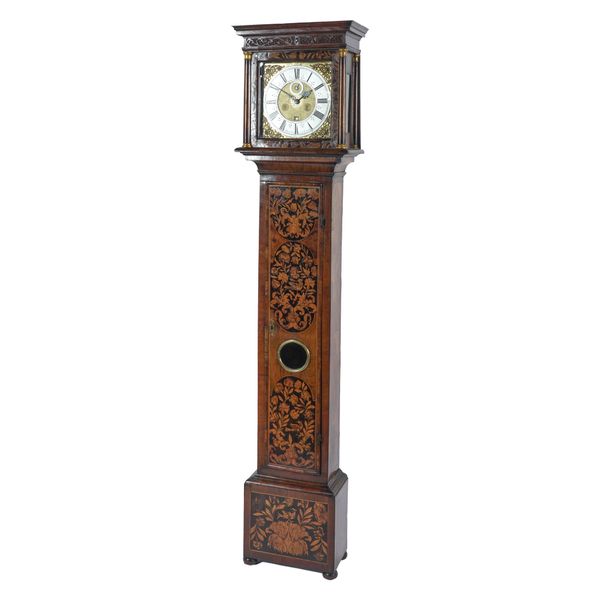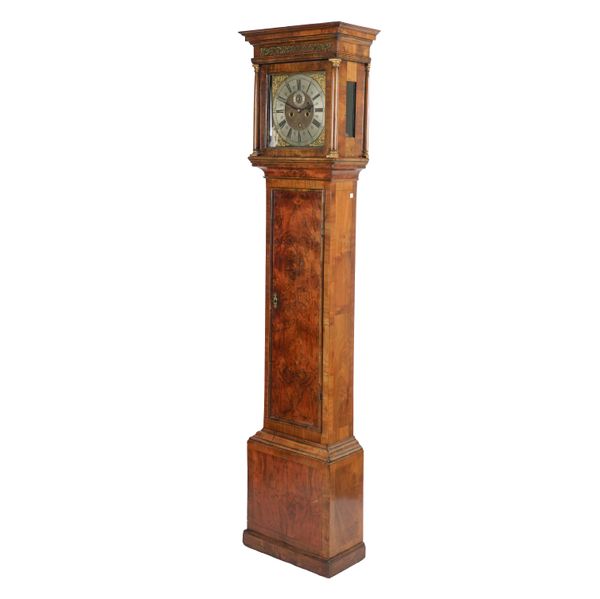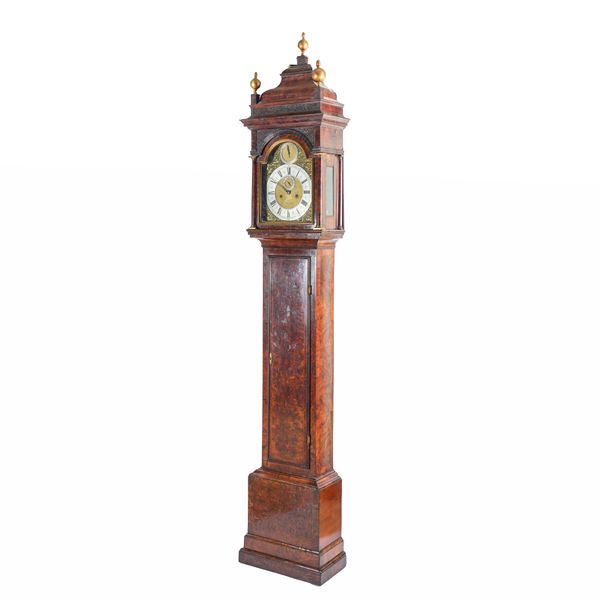
A FINE QUEEN ANNE BURR-WALNUT MONTH-GOING STRIKING LONGCASE CLOCK
| Starting bid | £18,000 |
| Estimate | £20,000 - £30,000 |
| Absentee deadline | Dec 3, 2025, 12:00:00 PM |
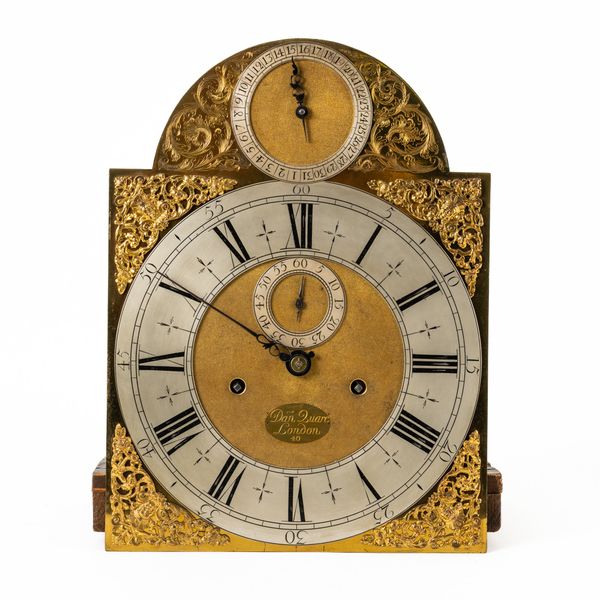
By Daniel Quare, Exchange Alley, London, No. 40, circa 1707
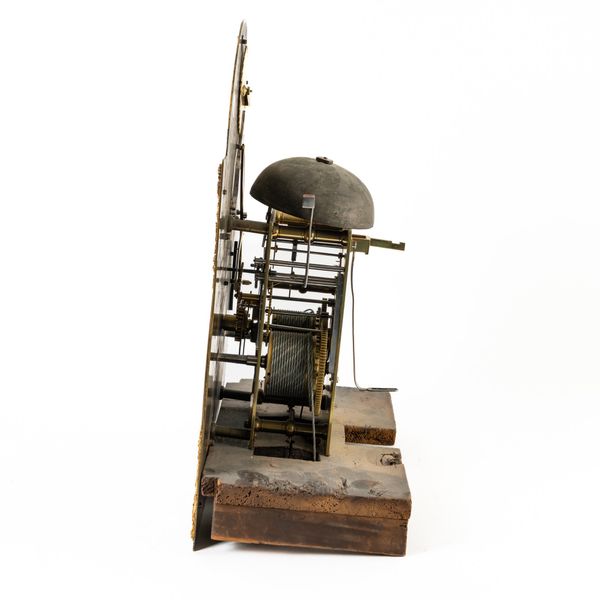
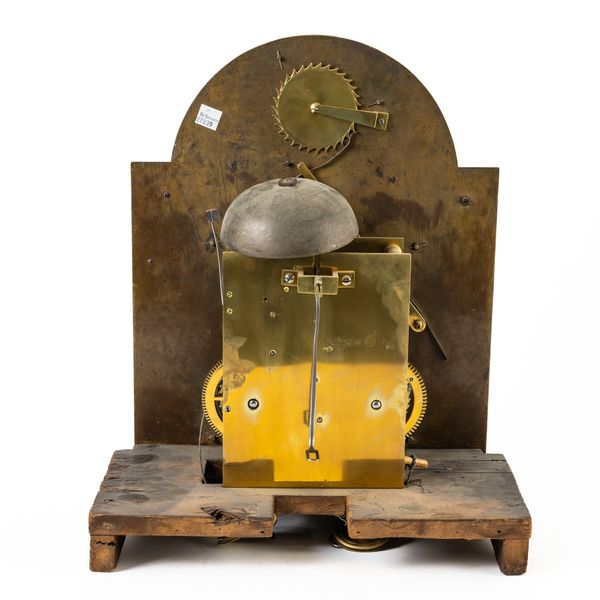
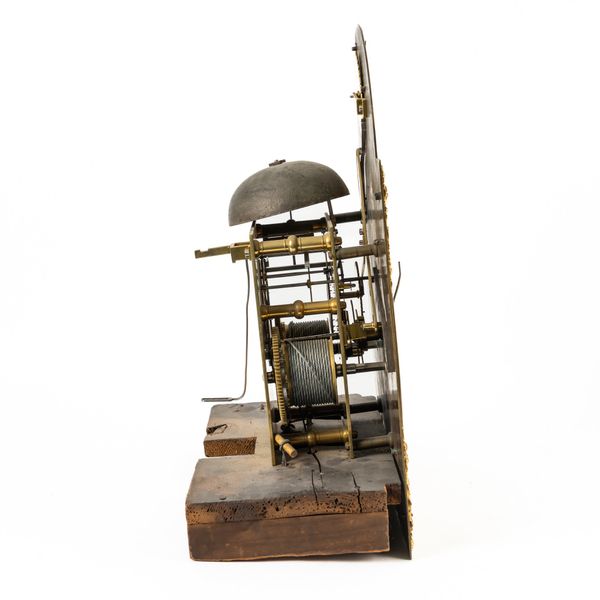
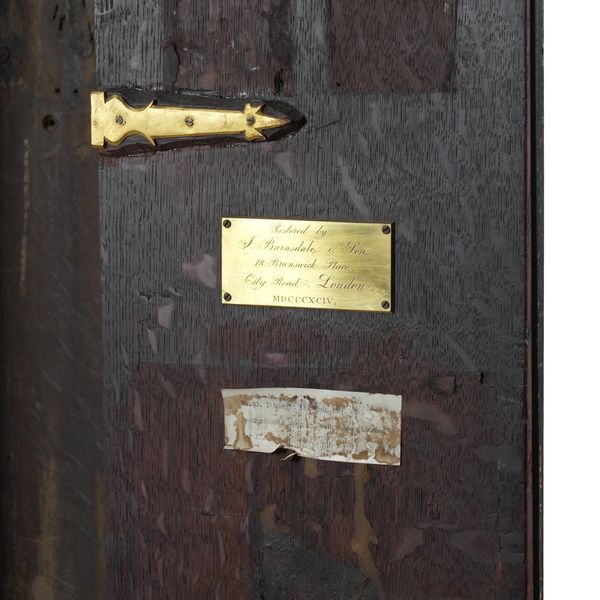
The case with three later giltwood finials surmounting the elaborate hood above fretwork rectangular panel, moulded projecting cornice with arched glazed door with finely-cast gilt-brass framing surround, flanked to each side by a gilt-capped three-quarter column, the sides each with a glazed panel and rear-quarter column, the trunk inset with a rectangular panel door outlined with a herringbone inlay, a brass engraved plaque to the inner back surface 'Restored by / J. Barnsdale & Son / 18, Brunswick Place, / Ely Road, London. / MDCCCXCIV.' on herringbone-outlined base and double stepped plinth; the 12in arched brass dial, with typical Quare style calendar ring to the arch, flanked by finely engraved foliate panels, the polished plate with Indian mask pierced spandrels, silvered chapter ring enclosing a matted centre with seconds subsidiary ring, finely cut blued steel hands and oval engraved signature panel Dan Quare / London 40 (with evidence of a later signature panel over), the twin train month-going movement with five finely turned columns, anchor escapement and hour rack strike on a bell
280cm high overall including finials
PROVENANCE:
Christie’s, London, 13 December 2000, lot 102 (£82,950)
Another walnut longcase by Quare & Horseman, No. 199, of the same size and pattern, was sold Bonhams, London, 29 November 2023, lot 47.
LITERATURE:
Richard Garnier & Jonathan Carter, The Golden Age of English Horology, Masterpieces from the Tom Scott Collection, Winchester 2015, illustrated on p. 280 and 281.
Garnier & Carter include a chapter on the life of Daniel Quare, together with a history of his production p. 261-332.
A notable rare feature of this clock is the bold brass moulding which frames the dial. Quare incorporates this on his magnificent year-going master-piece clock in the British Museum (illustrated in Garnier & Carter, p. 275).
Daniel Quare was born in Somerset in 1647. Admitted to the Clockmaker's Company in 1671, he was elected Master in 1708. He died in Croydon in 1724. Known as 'Quare of the backstairs', he, as a quaker, was not able to take an oath of allegiance to the King so was never formally granted 'Clockmaker to the King'. He invented the mechanism for repeating watches. He had an extensive business and was also renowned throughout Europe for his clocks.
WILLIAM JAMES BARNSDALE & SON
The City of London hold the archive for the Barnsdales at the Guildhall. They were watch and clockmakers during the 19th century. William Barnsdale was elected Master of the Clockmakers in 1906. Amongst the archive are the workshop's day and repair books, which may reveal more details about the clock and its history.
CONDITION REPORT
With winding crank key, flat brass rod and brass bob pendulum and a pair of heavy month-going brass-cased weights. Two case keys.
The clock is in good condition with evidence of restoration. The case has high quality veneers and is of a beautiful colour. As highlighted in the catalogue entry, the brass plaque on the inside of the door records the clock's restoration in 1894 by Barnsdale & Son, Brunswick Place. It has a replaced moulding to the left side of the trunk beneath the hood, as well as some replaced veneers. The trunk door lock is not original. The movement appears well cared for. Whilst in good order, it may now require a service. The hour hand is broken and present. The seatboard appears very old and possibly pine. It may be a later replacement?