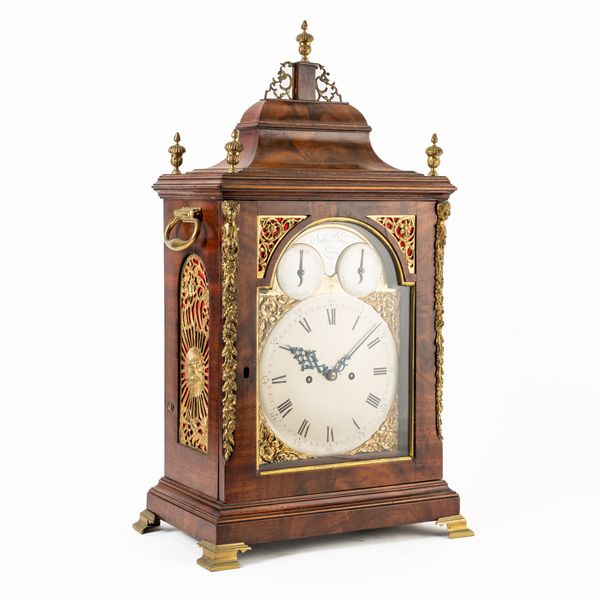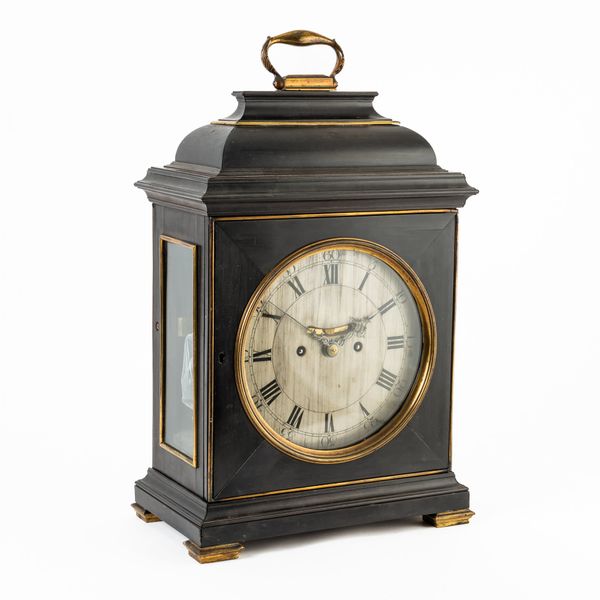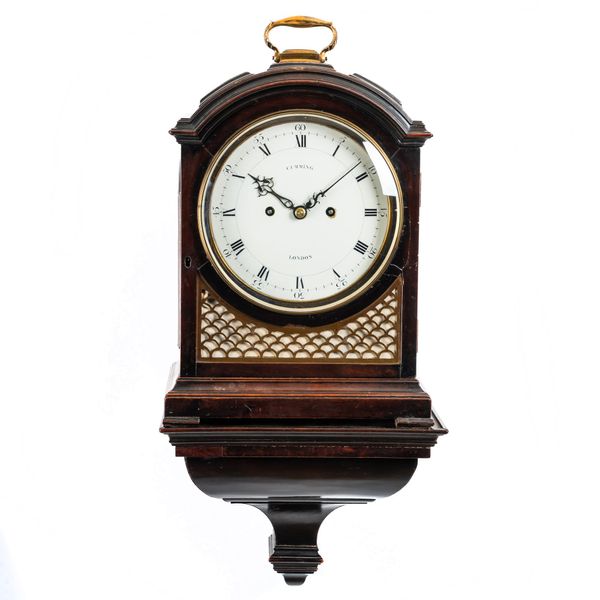
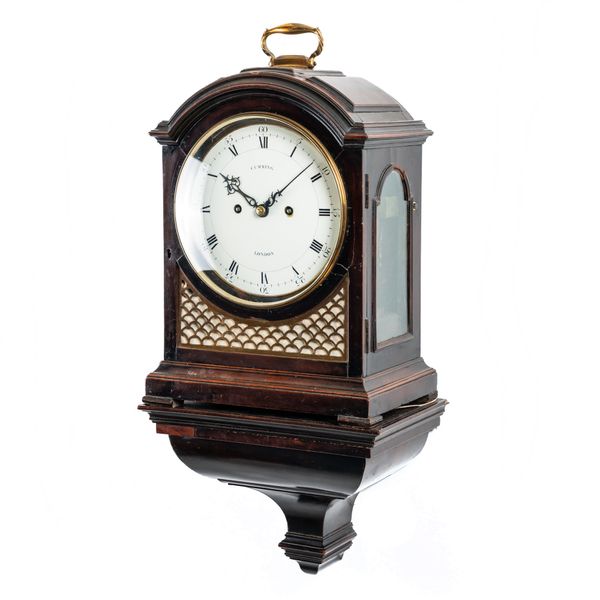
A GEORGE III GILTMETAL-MOUNTED FRUITWOOD TRIPLE-PAD TOP STRIKING AND REPEATING BRACKET CLOCK WITH PERIOD BRACKET
| Starting bid | £1,200 |
| Estimate | £1,500 - £2,000 |
| Absentee deadline | Dec 3, 2025, 12:00:00 PM |
By Alexander Cumming, London, circa 1770
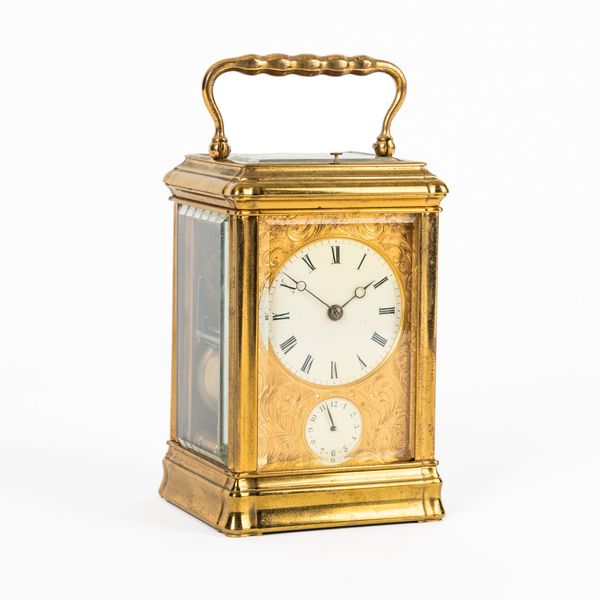
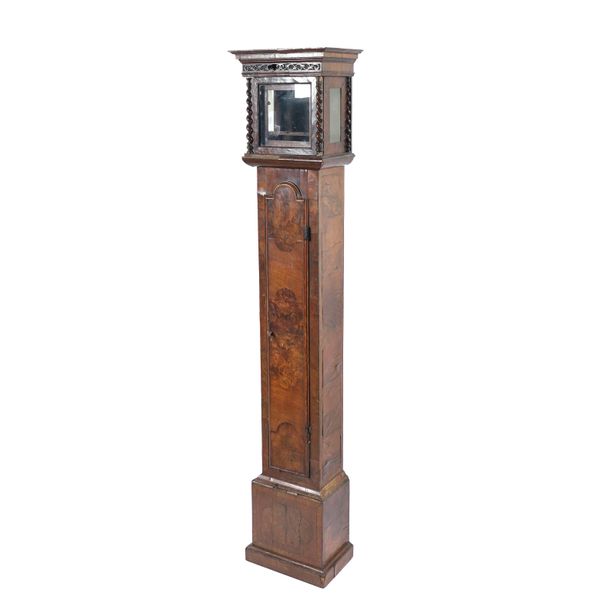
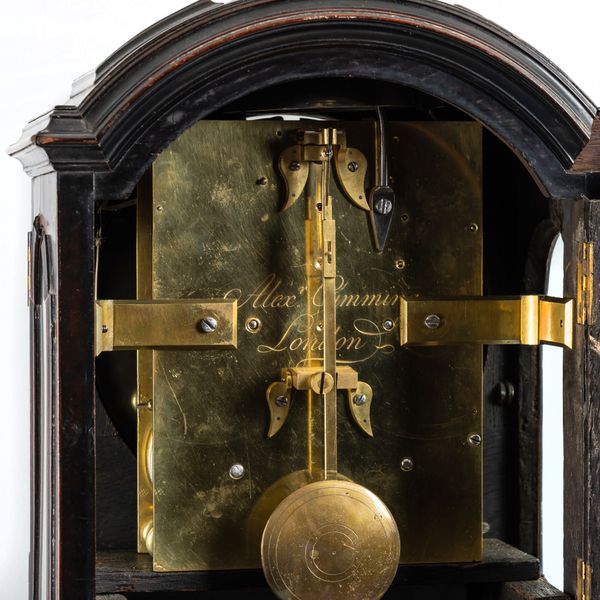
The case with a brass carrying handle over three pads, each with well cut moulded edges, with broken arch above the hinged glazed door with convex glass over 7in white enamel circular dial, signed CUMMING, LONDON, with pierced blued steel hands, strike/silent above the XII, with pierced brass fishscale panel below, the sides each with a broken arched-outlined glazed panel, on moulded base and block feet, the twin train wire gut fusée movement with rectangular plates signed Alex Cumming London, with anchor escapement and hour strike on a bell; together with a period bracket with concealed drawer
The clock 38cm high handle up
The bracket 19.5cm high
Alexander Cumming (c.1733–1814) was a Scottish watchmaker, inventor, and mechanician, believed to have been born in Edinburgh. His talent for mechanics brought him to the attention of Lord Milton, who introduced him to Archibald Campbell, the third Duke of Argyll. By 1752, Cumming was working in Inveraray, Argyll, as a watchmaker, where he and his brother John built an organ and made a long-case clock for Inveraray Castle.
After the Duke’s death in 1761, Cumming moved to London, likely with the support of John Stuart, third Earl of Bute, later Prime Minister to King George III. In 1763, he became a commissioner on the board that evaluated John Harrison’s marine timekeeper, an invention crucial to determining longitude at sea. Cumming’s reputation grew, and he crafted fine clocks and watches for notable clients such as Sir William Hamilton and Dr. Charles Blagden.
Honoured as an honorary freeman of the Clockmakers’ Company in 1781 and a Fellow of the Royal Society of Edinburgh in 1783, Cumming spent his later years in Penton Place, Pentonville, writing essays on mechanical topics. He died there in 1814, remembered as “eminent for his genius and knowledge in the mechanical sciences.”
CONDITION REPORT
With pendulum and key. The enamel dial is in very good condition, not restored. A chip to the going train arbour opening. The movement has been well cared for and is running. The securing knob for the pendulum holdfast is replaced. The case formerly ebonised, now showing the fruitwood. Marks and scratches consistent with age. Losses to moulding as follows: top of right hand side arch; back door left and right side at break arch; rear arched moulding - right side (facing) small joint from arch to side moulding.
The bracket - left side rectangular moulding on pull-out replaced. Shelf at back on right side has a small chip in moulding.
The bezel depth is unusual in relation to the dial. However there is no evidence of the case or movement being recased. Two empty screw holes to the underside which held the seatboard assembly.
A fine clock and I’d suggest once re-ebonised will look very well.